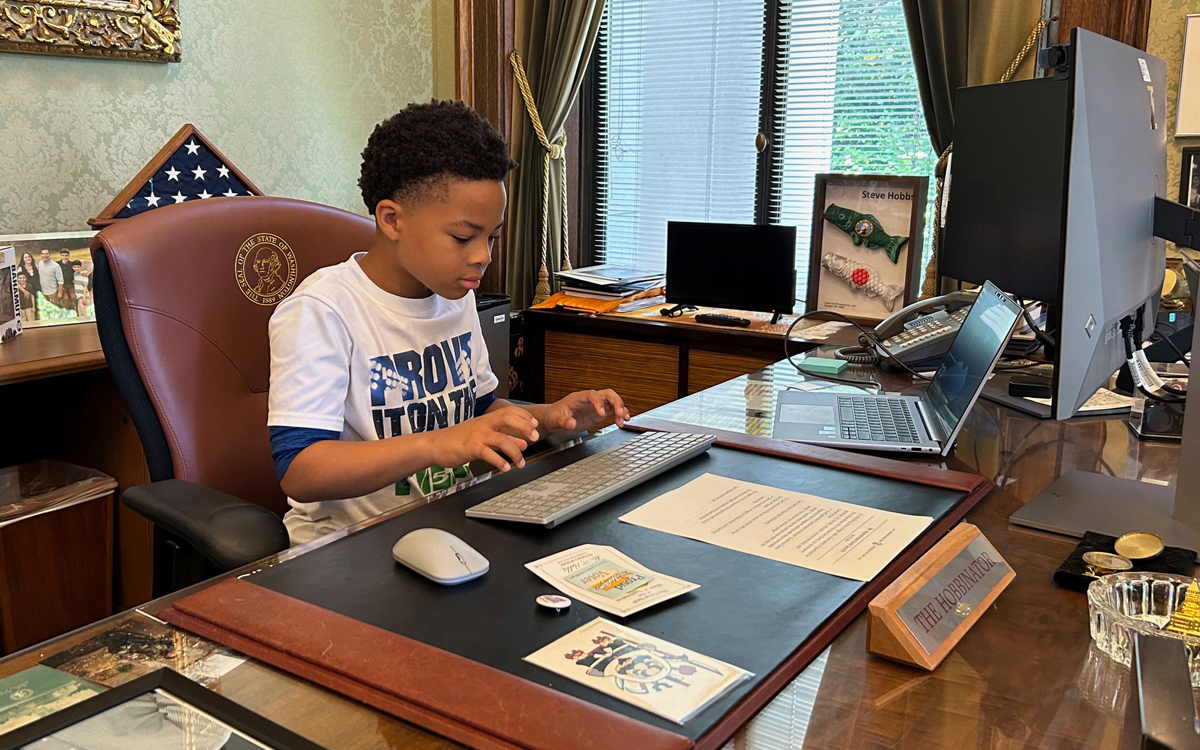
It's a wonder they spend any time sitting at their desks
All Seabury students have busy days chock full of learning opportunities. In addition to — and integrated with — the core curriculum, those include exposure to an array of enrichment and special programs, including physical education, Spanish, performance arts, library / literacy, artists in residence, field studies, and more.
Art
Art at Seabury is an exploration of creativity and self discovery. Students are taught techinical skills and encouraged to use those skills to create work inspired by themselves and their interests. Seabury art is primarily Choice-based art education which offers numerous benefits for students, including increased engagement, enhanced creativity, and improved critical thinking skills. By allowing students to make meaningful choices about their artwork, this approach fosters a deeper understanding of artistic concepts, promotes self-expression, and develops a sense of ownership over their creations. Students participate in annual art events like the Artcade, a handmade arcade, and the Trashion Show that utlizes recycled materials to create wearable art.
Performing arts
Students learn about and participate in all aspects of the production of a live theatrical play, both in front of and behind the curtain. On the production side, this includes creating an overall concept for a script, writing an outline, turning the outline into a rough draft of each scene and editing the rough draft into a final script. An organizational chart of jobs is used to show all of the departments of a production and after exploring each area, students choose a job to be responsible for, in addition to their role on stage. Jobs range from sound and light design to publicity to accounting. Each student designs a concept for the staging of one scene and all students will take part in building the final set as well as serving as stage crew during the live production. In front of the curtain, teams of at least one student per grade will act together to perform each scene.
Students practice how to act in front of an audience as an individual and with a team. Skills include learning a variety of songs and simple dances which teach them melody, counting beats, entrances and exits from the stage and timing, spatial awareness, vocal projection, body language, active listening and timing of responses. The performing arts program also supports students in developing confidence in public speaking, presentation skills, and teamwork.
Spanish
The Spanish program at Seabury uses the Organic World Languages (OWL) method, which introduces students to Spanish in a natural way through listening and mimicking, much like how toddlers acquire their first language.
In middle school, students build on this foundation by developing more advanced reading skills, exploring grammar concepts, and strengthening their writing all while continuing to grow as confident conversationalists in the target language.
OWL follows a student-led curriculum, where each lesson introduces multiple topics for discussion that naturally blend together as students discover how to use Spanish in real time. Games, activities, and songs conducted entirely in Spanish and supported with movement and visuals, guide and encourage students to playfully engage with the language.
Students may receive resources from school to practice Spanish independently or with their families. In middle school, they will be assigned homework designed to deepen their skills through grammar practice, reading exercises, writing prompts, and opportunities for cultural exploration
Physical Education
Lower school: Pre-k students have an opportunity to learn basic skills including ball skills, skipping, and their first try at jumping rope. They begin building motor skills, hand-eye coordination, and following directions. As students progress through kindergarten, first and second grades, they add complexity to basic skills. Third through fifth grade students practice more complex motor skills, ball skills, and the nuances of specific games and sports.
Middle school: The emphasis is on cooperative activities, variety and working within individual capabilities.
Throughout the PE program, there is an emphasis on mindfulness, how we treat our bodies, and how our actions affect those around us.
Library / literacy
Seabury School's library program supports and enriches the school's curriculum and its gifted students with a vital and ever-growing collection of physical and digital resources, including including more than 12,000 physical books, an ebook and audiobook collection through Sora, and the Britannica School online encyclopedia. Diversity, equity and inclusion are core values when building and curating our library collection. We also take advantage of resources offered by the three excellent public library systems that serve our region and offer reciprocal memberships to patrons.
Our library curriculum works to help students learn to navigate their way through the snowballing quantities of information in our society, with the ultimate goal being students who are effective, responsible, critical and independent users of information. Students are exposed to fiction and nonfiction and they learn to understand the difference. They hear and read literature in a variety of genres. They learn about the major children's book awards, including the Caldecott, Geisel, Newbery, Coretta Scott King, Pura Belpré and more. They learn to navigate the physical library and to select books of interest at appropriate reading levels. They learn to use physical and digital sources to solve information problems. They learn to use the computer catalog to find books on library shelves and develop an understanding of the Dewey Decimal system. We strive to develop in students an appreciation for literature and a love for reading.